Table of Contents
Which Parts of a Hydraulic Press Are Customizable?
In high-volume manufacturing, a standard hydraulic press can force trade-offs in cycle time, floor space, part consistency, and operator safety. If your operation includes forming, compacting, punching, or other demanding processes, off-the-shelf equipment may fall short on the precision, controls, and automation readiness you need to stay competitive.
For process engineers, operations leaders, and quality teams, customization is a vital strategy for safeguarding both throughput and repeatability. By integrating safety and connectivity requirements from the outset, customization helps reduce costly scrap and rework. Below, we’ll break down which hydraulic press parts can be tailored and how those options turn a standard machine into a production-ready system.
Customized Press Configurations
Based on tonnage requirements, part size, and available floor space, Multipress offers multiple frame styles that act as the starting point for a custom hydraulic press design. Aligning the frame, tonnage, and working envelope up front helps prevent downstream issues like die interference, alignment drift, and costly redesigns as volumes grow.
Frame Style
Multipress offers two main hydraulic press designs:
- 4-Post (4-Column) Frame: Provides maximum rigidity and precise ram-to-bed alignment, with access available from all four sides.
- C-Frame (Gap Frame): Offers a smaller footprint and access from three sides. These are available in two series:
- W7A Series: Compact bench press delivering 1-3 tons for precision work
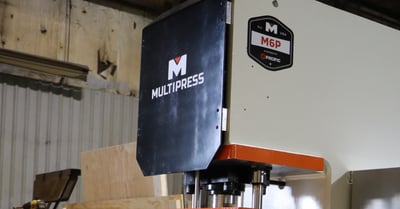
- M6P Series: Versatile bench press providing up to 20 tons of capacity
- FM Series: Heavy-duty C-Frame press offering up to 200 tons of capacity
- 2-Post Frame: Delivers strong and side access with a more open design, balancing rigidity and accessibility for a wide range of applications. This model is available through our custom solutions.
With the right frame style selected, you’ve established a stable foundation that supports accurate pressing, efficient access, and the hydraulic/control customizations you need to meet cycle time and consistency goals.
Tonnage Range
Multipress offers a wide range of hydraulic presses, categorized by tonnage and size. Benchtop units range from 1 to 20 tons, including the W7A Series (1–3 tons) and the M6P Series (6–20 tons).
For higher capacity, floor models include C-frames from 20 to 200 tons, and 4-post presses up to 1,200 tons.
Custom Dimensions
Beyond frame type, you can specify vertical clearance (daylight), stroke length, throat depth (on C-frames), and bed size to match your tooling and die requirements. This is also where you account for floor-space limits and operator access, two practical factors that directly affect changeover time and safe material handling.
Presses can also be configured as up-acting or down-acting based on your application and how operators will interact with the machine. This flexibility becomes especially important in 2-post and 4-post press designs, where frame structure directly influences accessibility, support, and load distribution. Choosing the right frame and capacity range gives you a stable platform for long-term accuracy and durability.
Hydraulics You Can Customize
The hydraulic system controls how fast, how hard, and how consistently your press operates. Customizing hydraulics is one of the most direct ways to improve cycle time and repeatability – so you’re not wasting energy or time during non-productive motion, and you’re minimizing variation from part to part.
Directional & Proportional Valves
Directional valves control the basic extend-and-retract motion of the ram and form the baseline of each hydraulic circuit. For high-tonnage applications, decompression circuits can be added to manage pressure release during retraction for smoother, more controlled operation.
Proportional valves add adjustable control over speed and force without the cost of a full precision system. This provides a significant step up from standard on/off valves, and joystick operation can be included for manual positioning tasks.
Hydraulic-Servo Systems
Hydraulic servo valves regulate the flow of fluid to actuators using digital or analog signals, enabling exceptionally precise and responsive control. Compared to conventional proportional valves, they deliver greater accuracy and dynamic performance in demanding applications.
Dual Pump (High/Low) Circuits
Dual pump circuits speed up the approach phase (before ram contact), then automatically transition to full pressing force when the ram meets the part. This reduces overall cycle time by minimizing time spent moving through open air.
Ejector and Stripper Cylinders
Add-on cylinders can be built in for part ejection, cushioning, or stripping. This is especially helpful in deep draw and forming operations where parts need assistance separating from the die.
Fine-tuning these hydraulic components helps the press run faster, extend component life, and produce more consistent parts.
[DD CTA: Floor Model Presses | 20 TO 200 TON CAPACITIES]
Electrical Controls and Operator Interface Options
The control system manages the pressing sequence, safety functions, and process precision. These hydraulic press parts can range from simple manual setups to fully programmable systems, depending on how complex your production requirements are.
Configuring controls to match your plant’s preferred hardware and workflows can also reduce troubleshooting time, training effort, and downtime – especially across multiple shifts.
Operator Interface
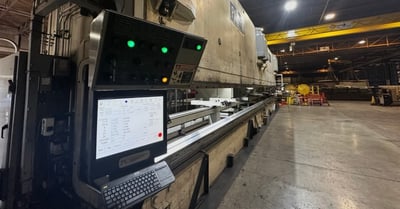
Options start with standard two-hand push buttons to help keep hands clear during each cycle. For more advanced needs, touchscreen displays (HMIs) support custom screens, saved cycle recipes, and real-time monitoring.
Logic and Programming
Choose your preferred PLC brand (such as Allen-Bradley) to align with existing plant standards and maintenance team familiarity. Additional inputs and outputs can be added to support sensors, safety devices, and automation connections.
Cycle Parameters
You can program how the press behaves at each stage of the stroke – dwell time, position- or tonnage-based reversal, and speed-change points can all be tailored by material and operation. Recipe-based settings also reduce reliance on tribal knowledge, helping operators run multiple part numbers with consistent outcomes and fewer setup-related defects.
Variable Frequency Drives (VDF)
VFDs adjust motor speed to match the load, helping reduce energy use and deliver smoother operation – especially when pressing demands vary throughout a shift.
With the right controls, the press becomes a programmable production tool capable of running multi-step cycles with repeatable results.
Quality Control, Process Verification, and Data
When production depends on traceability and consistency, your hydraulic press can also function as a verification system. By integrating sensors and data tools, you can monitor every stroke in real time and build a complete production history.
A “smart press setup,” as we call it, combines verification, monitoring, and data capture to address common challenges in traceability, consistency, and process documentation. Key features include:
- Signature Analysis: Compares each stroke to a pre-defined acceptable range and flags any out-of-range cycle with a pass/fail alert.
- Force and Precision Monitoring: Load cells and position sensors track applied force and ram position throughout the cycle, generating accurate data for every part.
- QC Circuit: Confirms the press fully completed its first stroke, helping catch incomplete operations before parts proceed.
- Data Logging and Recipe Storage: Exports production data in real time for reporting and compliance, while stored “recipes” allow fast recall of proven cycle settings.
Together, these tools create objective, time-stamped proof that each cycle met spec. Having this in hands allows you to support audits, diagnose process drift, and skip manual inspection steps that slow production.
Automation and Material Handling Integration
For many manufacturers, the press is only one component of a larger production line. Adding automation and material handling is often the most effective way to increase output – you don’t want your press to be the limiting step in an otherwise smooth process.
Whether you’re addressing staffing constraints or targeting a specific parts-per-hour goal, integration is about keeping the press fed safely and consistently.
Integrations include:
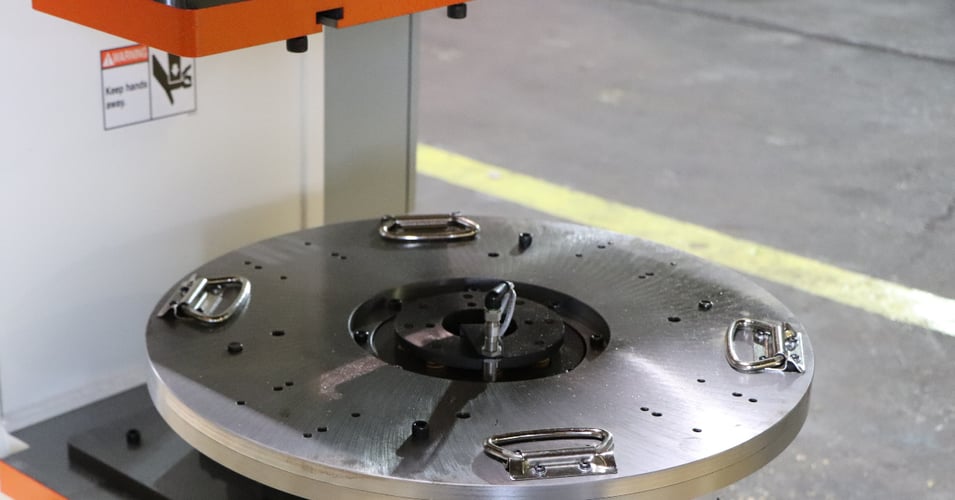
- Rotary Index Tables: Available with two to 32 stations to support multiple operations in a semi-automated cycle.
- Shuttle and Slide Tables: Move heavy tooling or parts in and out of the press safely, helping speed load/unload while keeping operators clear.
- Robotics and Feeder Integration: Multipress can build presses to be “robot-ready,” with the connections and safety interfaces needed for conveyors, feeders, and pick-and-place systems.
Operator-Assisted vs. Fully Automated
Not every application needs full automation. A Multipress engineer can help evaluate trade-offs based on cycle time, staffing, and safety requirements – so you invest where it impacts throughput and ergonomics most.
Safety Features: Design-In vs. Bolt-On
Safety is most effective when it’s designed into the machine – not added after the fact. Customizing safety features up front helps protect operators without creating unnecessary friction in loading, unloading, maintenance, or changeovers.
Safety features include:
- Light Curtains and Presence Sensing: Create an invisible barrier around the work zone; if the barrier is broken, the press stops immediately.
- Physical Guards: Custom mesh, barrier, or sliding guards block access to the pressing area while still enabling maintenance and die changes.
- Two-Hand Controls: Dual push buttons require both hands to initiate a cycle, helping keep hands clear before motion begins.
For general guidance on machine guarding, see OSHA standard 1910.212.
Ready to Customize Your Hydraulic Press Parts?
Customization turns a standard press into a competitive advantage – aligning performance, safety, verification, and integration to your real-world process. By tailoring the frame, hydraulics, controls, and quality systems, you get a solution engineered around your parts, your cycle time targets, and your operational constraints.
To speed up requirements scoping and quoting, come prepared with your part/tooling details, target cycle time, quality/traceability requirements, and any automation interface needs. Multipress can then translate those inputs into a build specification that supports consistent parts, safe operation, and scalable production.
Ready to build your ideal machine? The Multipress team specializes in turning complex requirements into high-performing custom hydraulic press solutions. Contact us today to request a quote and start designing a press that fits your operation.
.png?width=400&name=Multipress%20Offering%20Blog%20Image%20(1200x628).png)