Table of Contents
What Are Hydraulic Shop Presses Used For? Application Guide
Hydraulic presses have multiple uses. But are they versatile enough to be worth the investment for your shop floor?
A hydraulic press uses fluid to generate a large amount of force for a variety of tasks, like bending, straightening, pressing, and shaping metal parts.
We’ll take a look at each of these applications, including the industries they’re often used in. Keep reading to learn when this investment can be a very cost-effective decision for your business, and how to pick the best option for your workspace.
Typical Hydraulic Shop Press Applications
| When You Need: |
Press to Use |
Use Cases |
| Controlled, gradual, precise force |
Hydraulic press |
Bearing installation and removal, compacting metal scraps |
| Slow, even pressure to avoid cracking |
Hydraulic press |
Reshaping bent components |
| Multipurpose capability |
Hydraulic press |
Blanking, punching, and realignment work |
| Fast, repeatable cycles with high-volume productions |
Mechanical press |
Repetitive blanking or punching |
| Efficiency and part-per-minute output |
Mechanical press |
Automotive components and appliance brackets |
Hydraulic presses are known for their ability to apply a controlled force using Pascal’s Law. The pump produces a flow that moves into one or more hydraulic cylinders, where it’s mechanically multiplied, providing the force required to shape materials.
This function of applying gradual force allows hydraulic presses to excel in precision and efficiency, enabling them to be used for a variety of applications. Uses for hydraulic presses include:
- Bearing installation and removal: Presses can push bearings in or out of shafts without causing damage, ensuring bearings are aligned correctly during installation. Production becomes far more efficient using a press versus manually installing and removing bearings, reducing time and labor costs.
- Straightening and aligning: When components, such as a metal rod or shaft, become bent or deformed, the press accurately straightens and reshapes the part, eliminating the need for additional grinding.
- Folding: The hydraulic press holds the piece of metal firmly in place, pressing it in the middle to bend the edges upward. Even with the immense force, the process is gentle on the material, making damage unlikely.
- Blanking: Cutting a specific shape or form from a sheet of metal. Typically, this shape goes under further processing.
- Punching: Also known as piercing, it’s the process of punching or cutting openings in a metal sheet to form a shape. Unlike blanking, in punching, the cut-out section becomes scrap.
- Deep drawing: Metal is pulled through the die of a press, stretching it thinner. The reduced opening of the die causes the material to reshape and decrease in thickness.
- Compacting: Metal scraps or powders are placed into a mold and pressed into a smaller, compact size, making them easier to recycle or dispose of.
Industries and Examples of Hydraulic Press Use
Because hydraulic presses combine high pressure with precise operation, they serve a wide range of industries. Their unique balance of power and accuracy makes them an ideal solution for manufacturing a variety of products, from small, delicate components to heavy-duty parts. Their ability to shape and straighten also makes them a welcome addition in maintenance and repair settings.
| Common Industries |
Examples |
| Automotive |
Body panels, gears, brake pads, and shafts |
| Maintenance departments |
Straightening bent rods, shafts, and brackets; reshaping deformed parts |
| Home appliance |
Washing machine drums, appliance frames, and metal housings |
| Aerospace |
Airplane wings, structural panels, and turbine blades |
| Medical |
Surgical tools, equipment housings, prosthetics, and orthopedic components |
| Military |
Armored vehicles, protective equipment, and firearm parts |
How to Select the Right Hydraulic Press for Your Workspace
A hydraulic press is a big investment for your business. Knowing the correct steps of the selection process will allow you to avoid wasted time in the selection process, and more importantly, wasted money if you choose the wrong one.
When choosing which hydraulic press is best for you, consider the following factors:
- Tonnage requirements: Don’t forget to factor in material type.
- Workspace size and press configuration (bench vs. floor): Measure the physical space available for the press, factoring in the area needed for operation and maintenance.
- Size of your workpieces: Determine what size bed and stroke length are required to accommodate the dimensions of the pieces you’ll be working on.
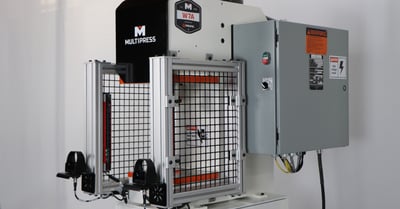
- Operator safety and ease of use: Look for built-in safety systems, such as emergency stop buttons and safety guards. Also consider the level of automation required – some presses offer highly programmable controls, while simpler tasks may only require basic operation.
Hydraulic Shop Press: A Single Tool With Many Benefits
Hydraulic presses are a single tool that can serve many functions, reducing downtime and equipment costs for your operations. The versatility offered makes their return on investment huge. Not only does one piece of equipment perform many functions, but hydraulic presses also add efficiency and speed to your production process, decreasing labor costs and increasing profitability.
Multipress offers a full range of hydraulic presses to meet various needs and requirements. Explore their brochure to find the press that’s right for your operation.
.png?width=400&name=Hydraulic%20Safety%20Blog%20Image%20(1200x628).png)